The Penitence of the Worm (2)
September 23, 2025
Tools for the autistic slave: my practical guide
July 18, 2026In mid-2024, the official confirmation of the last piece of my life’s puzzle arrived, and truly the most important one: I am autistic. The absolute certainty, however, had hit me earlier that year while watching the BBC documentary series Inside Our Autistic Minds, presented by Chris Packham. It was especially with the case of Flo that I connected immediately, seeing the daily effort of social masking reflected in her; I started crying from pure emotion, seeing myself so deeply reflected. Just like in her case, the official confirmation came to me at 45 years old.
(For anyone interested in watching this documentary, it can currently be found on the BBC, on various streaming platforms, and in key clips on YouTube).
I could go on for paragraphs here talking about the impact, the tears for so many years of misunderstanding, and feeling broken. Analyzing every painful social interaction, the exclusion, the mental blackouts, or those moments of freezing and running away that finally made sense. It was the liberation of starting a process with a therapist who helped me understand myself and love myself for who I am.
Along the way, I have also understood how my presence in the kinky world and my way of enjoying BDSM have been deeply connected to autism. But before going into future posts to break down how leather world sessions and dynamics intertwine with my neurodivergence, today I need to strip down before you. I need to talk to you about the internal experience. About how the spectrum feels and what it truly means to collapse when the brain gets saturated.
Art as a mirror of emotional blindness
Autism is a spectrum; it is not a straight line that goes from “less” to “more”. It is a dynamic range of intensities, colors, and traits. Not all autistic people feel the same way or process stimuli under the same pattern. In the same way, neurodivergence is a very broad umbrella where each condition works under different and not always comparable logics, but where we are united by that different fit with the majority due to deeply diverse ways of perceiving reality.
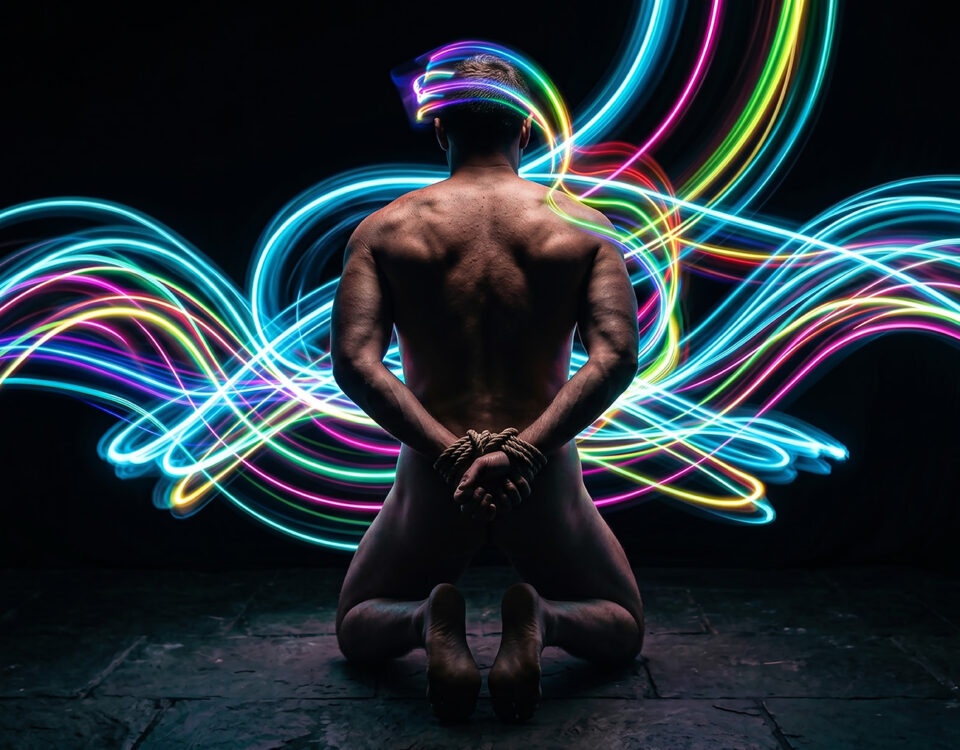
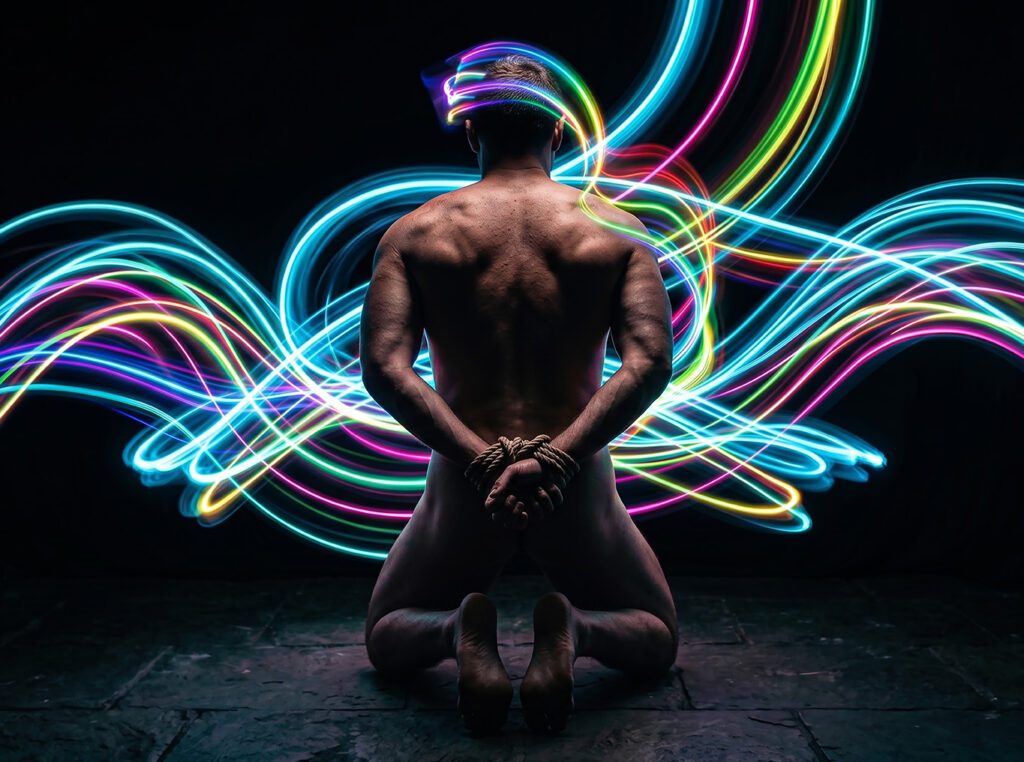
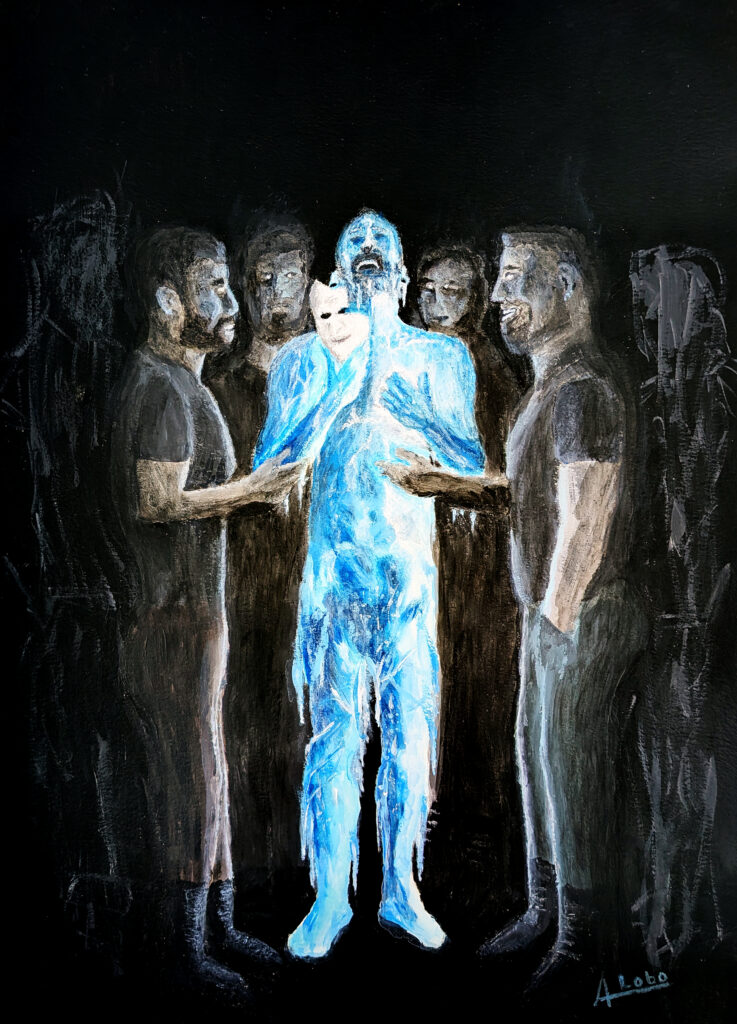
“Colapso” (Collapse) represents my own experience within that map, and painting it has been an act of absolute catharsis. The painting shows exactly the anatomy of a meltdown just as I experience it.
Imagine being surrounded and suffocated by the social group you think you belong to after years of rejection; when you feel that, finally, you are not going to be cast aside because you have found your tribe, people like you who wear leather or rubber and who seem close, inclusive, smiling. But suddenly, something happens. A trigger that is invisible to them breaks you inside. In an instant, you are unable to hold the social mask (masking) for one more second. You freeze. You feel a sharp pain that freezes you, coming straight from the heart; a cutting cold that, paradoxically, flows like a blue light illuminating others while you scream from within, frozen and naked.
Around you, the environment turns black. Those who surround you are no longer friends: they transform into ghosts, into blurry threats. Your whole body screams to run away, but you can’t. You are trapped, petrified in the middle of the stage. That is ‘Colapso’, my autistic meltdown.
The restaurant scene: predicting the cliff
A year ago, I experienced this painting in my own flesh during a birthday dinner at a restaurant. We were with friends. Because of the order we arrived, I ended up sitting in the middle of the table, an exposed spot. The noise of the place and the intensity of the interaction were charging my battery in silence, without me realizing it.
In an attempt to join the conversation, the topic of Christmas decorations came up (something I am passionate about and that generated a special melancholy for me that year). While sharing with excitement my plans for the garden for those dates, my husband, carried away by his own stimulation, started to answer for me in a joking way, which everyone saw simply as a typical group social joke.
It is usually very hard for autistic people to naturally understand double meanings, irony, or when an intervention is just a game. For my brain, that was an emotional kick, one more among so many others that I have accumulated throughout my life and that, inevitably, transport me suddenly to that dark and lonely place.
Knowing that the noise in my head was growing by the second, I froze, unable to communicate that I needed to go out to the street to breathe. I became blindly emotional. Unable to channel the pain, I reacted by causing emotional damage to my partner, hitting back like a wounded animal that feels cornered. I shrank before the uncomfortable looks of my friends and stayed trapped in a loop of rage and internal devastation, hidden behind a fake smile. It was a situation that drained me completely, left me exhausted, and forced my mind to absorb all that impact in a very harsh psychological state.
That painful disconnection was, precisely, the trigger that led me to change the rules of the game. Instead of isolating myself, I talked about it later with my husband and, after the necessary apologies but without feeling guilty anymore, I decided to share it with the friends who were at the dinner. I openly told them that I am autistic; I didn’t keep it to myself because I felt no shame. I needed them to be part of my reality so that, if something like this happened again, they would know how to accompany me in that moment and could also give a name and shape to the situation. Far from pulling away, they supported me completely. They confessed that they had been very worried during the dinner and simply hadn’t known how to help me at that moment. They showed me all their support and were genuinely interested in understanding my way of processing the environment to know how to help me in the future. In the end, true friends understand you.
The big difference from all previous times was that on this occasion I didn’t run away or break relationships: I stayed and I resolved it. As part of this learning, I have accepted that I cannot avoid meltdowns or shutdowns once I am already submerged in them, but I can radically change the way I recover: sharing what is happening to me with my environment instead of throwing them out of my life, blaming them, or hiding in shame. Also, now I know how to predict when I am close to the cliff: if I see it coming, I politely leave the environment to decompress (going to the restroom or going outside to breathe fresh air), and I always try to sit on the outermost part of a table to avoid being trapped in the middle of the social crowd.
Looking back, I understand that this lack of strong communication channels also caused trouble during my kinky beginnings. Reviewing my memories, I can identify meltdowns with my Master because a situation overwhelmed me or he did something in the session that I hadn’t known how to communicate beforehand. It was our beginning; I had explosions that, due to guilt, I naturally accepted as punishments for my bad manners. The same thing happened at big fist parties, where the social saturation was so overwhelming that I decided to avoid them completely, discovering that my well-being relied exclusively on 1-on-1 sessions.
What I need to share: understanding the real impact
For an autistic person, it is a lifesaver for their close environment to perfectly understand how their mind works. Living with the constant possibility of collapsing is a very heavy invisible burden, and it is crucial that those around us stop judging these states under the neurotypical lens:
Masking (Social Camouflage): It is the constant effort, whether conscious or unconscious, to hide my autistic traits and adopt neurotypical behaviors to fit in and not be rejected. It means forcing smiles, calculating when to make eye contact, or mentally rehearsing conversations. It is an exhausting performance; that heavy burden of trying to get validation and inclusion through an effort that burns your brain from the inside, destroying you mentally and leaving you feeling bad at the end of the day, but with the bittersweet reward of having achieved that highly desired integration and acceptance.
Meltdown (Collapse): This is not a childish tantrum or a fit to get attention. It is a biological and involuntary response to an absolute sensory or emotional overload. When the weight in the backpack saturates, the brain enters survival mode and I explode like a “justice volcano”, taking out emotional scalpels against the people I love the most. Afterwards, I am flooded with a terrible guilt because of the way I exploded.
Shutdown (Blackout): This is not a simple voluntary disconnection or “not wanting to talk”. It is the collapse turning inward; it happens when the brain decides to turn off external systems to protect itself from saturation. Like what happened to me at the restaurant: paralysis, mutism, and absolute isolation while walking among ghosts that just a moment ago were my loved ones.
- Stimming (Self-Regulation): Consists of repetitive behaviors or movements (physical, verbal, or mental) that serve to balance an overstimulated or anxious nervous system. It is not something strange that should be ridiculed or suppressed; it is the natural and essential mechanism our brain has to release tension. In my case, facing the suppression of other more visible and conventional forms of self-regulation, I found my own ways of stimming through BDSM, as I will explain in detail in the next post.
Autistic Burnout (Autistic Exhaustion): A prolonged state of mental and physical emptiness, and loss of skills caused by months or years of social camouflage (masking). The constant attempt to be someone social to find a fit made me experience an extreme situation in 2011. It was a time when, after learning social rules on a theoretical level, I dedicated myself to experimenting with them without realizing that I was doing constant and massive masking in too many new environments. What I believed at the time to be a simple work burnout actually had much more to do with autistic burnout. I overcame it without realizing it when I chose to take a break from my attempts to emulate others in formulas of massive social acceptance; I decided not to expand my social life to group circles (like work after-hours events) and return to the 1-on-1 format with my closest circle of friends, which naturally did not generate the burden that was sinking me. That selective isolation I sought is something I now understand as the exact pause my body needed to recover.
From defense mechanisms to celebration
By not understanding before that I have a social disability, I wasn’t able to see that I was the one who had to understand the situation from another perspective and talk about it. Now, with psychological support, I have learned assertive communication mechanisms to avoid being dragged down by those old defensive habits; especially with the people who love me and who, in reality, do not act with any bad intentions.
And even more important: I no longer feel broken, but different. It is true that opening the Pandora’s box of my adolescence has left me in a moment of unprecedented vulnerability. It terrifies me to show myself like this before my loved ones out of fear that they will pull away from me, as happened so many times in my childhood after a collapse. But the diagnosis has brought me an invaluable gift: the liberation from guilt.
And it is extremely important for me to bring all of this into the context of BDSM and this blog, because in the end BDSM is social: it is relationship, it is connection, and it is communication. Although within these practices I bring elements of excellence thanks to the special capabilities that an autistic person possesses, it is fundamental to recognize that my whole way of living, expressing kink, and fitting into the community has distinct points. That places me in a minority within this minority that is already our environment; something that must be recognized and, once free of guilt, celebrated.
Meanwhile, this blog does not change its direction, but it will have new nuances, since from now on there will be an explicit point of view from the spectrum. Because my lines are directed to those who embrace neurodivergence, autism, and alternative ways of connecting in a world that often turns out to be too noisy.
For those of you who find yourselves on this same journey of discovery or want to understand it better, I highly recommend two readings that have helped me gain perspective: The Power of Neurodiversity: Unleashing the Advantages of Your Neurodivergent Brain by Thomas Armstrong, and Unmasking Autism: The Power of Embracing Our Hidden Neurodiversity by Dr. Devon Price.
Thank you for joining me to the center of my black world. In the next post, I will tell you how, without ever imagining it, I adopted BDSM as my lifesaver and my way of stimming.